


Why Hair Product Leaves Flakes: Causes and Fixes
Table of Contents
- Why Hair Product Leaves Flakes: The Real Causes
- The gel cast: when crunch turns to white residue
- Signs of Hair Product Incompatibility
- How to Remove Product Buildup From Hair
- How to Apply Hair Gel Without Flaking
- Climate, Humidity, and Flaking: What Changes
- Fixing Flakes Without Losing Hold
- Frequently Asked Questions
Last Updated: September 10, 2026
Why Hair Product Leaves Flakes: The Real Causes
Hair product flakes in your hair after styling almost never mean dandruff. They usually mean one of three things: too much product, the wrong product for your hair, or a styling technique that lets residue dry in visible clumps. If you have ever run a hand through your hair at 2 p.m. and watched white specks drift onto your shoulders, the culprit is almost certainly product residue, not a scalp condition.
Below, we break down exactly why hair product leaves flakes, how to spot an incompatible formula, and how to fix it without losing your hold.
The gel cast: when crunch turns to white residue
A gel cast is the stiff, crunchy film that styling gel forms around curls as it dries (peer-reviewed research). It is a deliberate result, not a defect. The cast protects curl definition while hair dries, then breaks apart when you scrunch it.
The trouble starts when that film never fully breaks down. Left intact, the cast rubs against itself, collects dead skin cells and dust, and sheds as white flakes. Hard-hold gels with high concentrations of film-forming polymers are the most likely offenders, because they leave a thicker, more brittle film. Flexible-hold formulas dry into a softer film that resists flaking, which is why they suit daily wear better than maximum-hold gels.
What is actually in the film
Most gels build their hold from one or more of these film-formers, and each one flakes differently:
- PVP (polyvinylpyrrolidone), a rigid, water-soluble polymer that dries into a hard, glassy film. It gives strong hold but is the most brittle of the common film-formers, so it cracks and sheds white when the cast is over-applied or left unbroken.
- VP/VA copolymer, a PVP-vinyl acetate blend. Softer and more flexible than straight PVP, so it flakes less while still holding shape.
- Polyquaternium-11 and Polyquaternium-4, cationic polymers that carry a positive charge. They bond to the negatively charged surface of damp hair, which spreads the film more evenly and reduces the patchy clumps that dry into visible flakes.
- Carbomer and acrylates copolymers, thickeners and film-formers that give gel its body. In high concentrations they leave a tacky, residue-prone film that grabs lint.
A gel that lists PVP near the top of the ingredient panel will cast harder and flake more readily than one built on VP/VA or a polyquaternium. That single label detail explains most of the difference between a gel that crunches cleanly and one that snows on your shoulders.
Why porosity changes how the cast behaves
Hair porosity, how readily the cuticle layer absorbs and releases moisture, decides how much polymer sits on the surface versus sinking in.
- Low-porosity hair has a tight, flat cuticle. Product sits on top rather than absorbing, so film-formers build up in a thick surface layer. The cast sets hard, cracks easily, and flakes. Low-porosity hair usually needs less product and lighter film-formers, not more.
- High-porosity hair has a raised, open cuticle with gaps along the strand. It drinks in product, so the film that remains on the surface is thinner and the cast feels softer, sometimes too soft to hold. High-porosity hair can carry a stronger film-former without flaking, but it also absorbs residue deep in the strand, which is why buildup is harder to rinse out.
- Medium porosity sits between the two and tolerates most formulas without drama.
A common pattern is that a man with low-porosity hair blames his gel for flaking when the real issue is that his cuticle never let the product in. The fix is a lighter film-former and a smaller quantity, not a different brand.
Sticky vs crunchy: what the texture tells you
Sticky hair and crunchy hair point to two different problems, and confusing them sends you down the wrong fix.
A sticky, tacky feel usually means you applied too much product, applied it to soaking-wet hair, or used a water-based formula in low humidity where it never fully sets. The residue stays semi-liquid, grabs lint, and looks greasy rather than flaky. Sticky residue is a dosage and drying problem.
A crunchy, brittle feel means the product set too hard. That film will crack and shed. If your hair feels stiff by noon, you are using a hold factor stronger than your hair texture needs. Thick, coarse hair can carry a strong hold; fine hair usually cannot. Crunchy residue is a formulation and hold-strength problem.
The practical test: press a clean finger into the cast. If it dents and stays tacky, you have a dosage or drying issue. If it cracks and flakes off, you have a hold-strength issue.
Signs of Hair Product Incompatibility
Product incompatibility shows up as more than flakes. Watch for these signals that your formula and your hair are fighting each other:
- White or gray residue that reappears hours after styling
- Crunchy texture that cracks when you touch it
- Flaking that gets worse as the day goes on
- A dull, dusty look instead of shine or a clean matte finish
- Buildup that feels waxy even after washing
Layering is a common hidden cause. Many men apply a leave-in treatment, then a gel, then a spray. If the first layer is oil-based and the second is water-based, the two can separate and dry into visible flakes. The fix is simple: keep your layers compatible. Water-based products sit well under other water-based products. Oil-based sealants should be the last thing you apply, never the first.

How to Remove Product Buildup From Hair
You cannot fix flaking on top of buildup. Strip the residue first, then rebuild your routine.
- Rinse with warm water for a full minute to loosen surface product.
- Apply a clarifying shampoo and massage it into the scalp, not just the ends.
- Leave it in for one to two minutes so it can break down polymer residue.
- Rinse thoroughly, then repeat once if your hair still feels coated.
- Follow with a lightweight leave-in treatment to restore moisture.
A clarifying shampoo does the heavy lifting here because standard daily shampoo often leaves polymer film behind (the American Academy of Dermatology). The Canadian Dermatology Association's guidance on scalp and hair care notes that residue left on the scalp can cause irritation and itching, which is another reason to wash out styling product properly rather than layering more on top.

How to Apply Hair Gel Without Flaking
The single biggest cause of hair product flakes is applying gel to hair that is too wet or using far too much. Start with damp, not dripping, hair.
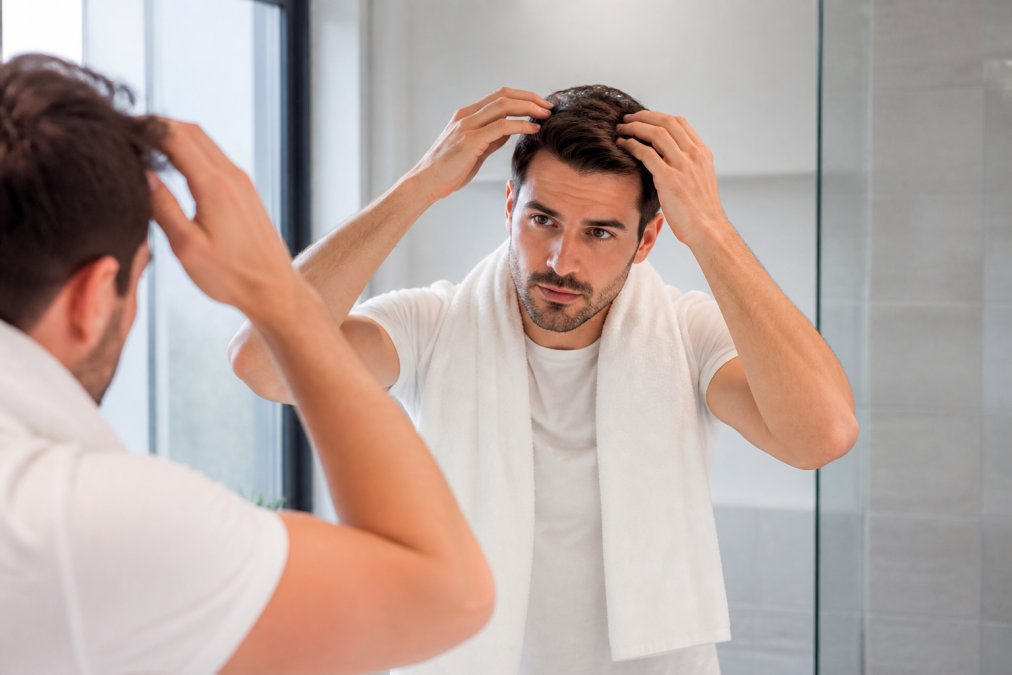
- Towel-dry hair until it is damp, not dripping. Excess water dilutes the gel and pushes it into clumps.
- Dispense a small amount, roughly the size of a coin, into your palms.
- Rub your palms together to warm and spread the product.
- Work it through from mid-length to ends first, then the roots.
- Comb or finger-comb to distribute it evenly. Uneven distribution is what dries into flakes.
- Let hair air dry or diffuse on low heat.
- Scrunch gently once fully dry to break the cast.
Product distribution matters more than product quantity. A thin, even layer holds better and flakes less than a thick, patchy one.
Climate, Humidity, and Flaking: What Changes
Humidity changes how your product behaves, and most men never adjust for it. The single number that matters most is the dew point, the temperature at which air can no longer hold its moisture. It is a better guide than relative humidity, because relative humidity shifts with temperature while the dew point reflects the actual moisture load in the air.
A rough working scale:
- Dew point under 10°C, dry air. Water-based gels set fast and hard, which raises the odds of a brittle, flaking cast.
- Dew point 10-16°C, comfortable range. Most gels behave predictably and casts break cleanly.
- Dew point 16-21°C, humid. The film starts absorbing moisture from the air and turns tacky.
- Dew point above 21°C, very humid. Water-based films may never fully set, so they stay sticky, grab lint, and look greasy rather than flaky.
Why the same gel flakes in one city and not another
A water-based gel dries by losing water to the air. In dry air, that happens fast, so the polymer film sets quickly and hardens into a brittle sheet, the classic flaking cast. In humid air, the film cannot shed water fast enough, so it stays semi-liquid, never locks into a cast, and instead turns tacky and lint-grabbing.
The counterintuitive part: flaking is more common in dry conditions, and stickiness is more common in humid conditions. If you travel between a dry climate and a humid one and your gel suddenly stops working, the formula did not change, the air did.
How to adjust
- In dry air: switch to a flexible-hold product to avoid a brittle cast, apply to damp rather than soaking-wet hair, and air dry. A light leave-in under the gel slows water loss and softens the film.
- In humid air: use a slightly stronger hold so the style does not collapse, and diffuse on low heat rather than air drying. Heat drives off surface moisture and helps the film set when the air is too wet to do it for you.
- In both: reduce quantity. A thin, even layer sets more predictably than a thick one in any climate.
The glycerin caveat
Many gels and leave-ins list glycerin, a humectant that pulls moisture from the air into the hair. In moderate humidity it adds softness and definition. In very humid air (dew point above roughly 21°C) it can pull in so much moisture that the film turns tacky and the style droops. In very dry air it can pull moisture out of the hair instead, leaving the cast brittle and prone to flaking. If your routine works in spring and fails in a humid summer, glycerin is often the variable.
Fixing Flakes Without Losing Hold
You can keep all-day hold and still kill the flakes. The trick is to change the formula and the technique, not to abandon styling product entirely.
- Switch from a maximum-hold gel to a flexible-hold formula that dries soft.
- Reduce your quantity by half and see if hold survives. It usually does.
- Apply to damp hair, never soaking-wet hair.
- Stop layering oil-based and water-based products in the wrong order.
- Clarify once a week to prevent buildup from compounding.
This is where the right products do the work for you. Jones Horizon offers premium, engineered grooming solutions designed specifically for the modern man. Our collection of conditioners, styling sprays, gels, and clays provides all-day hold and healthy nourishment without any crunch or flaking, so you get definition and a clean finish instead of white residue. Pair a flexible-hold styler with the Catalyst Clarifying Shampoo | Deep Clean & Refresh to strip buildup weekly, and follow with the Equilibrium Leave-In Treatment | Lightweight Hydration & Shine so hair stays hydrated and soft rather than dry and brittle. If you want the full routine in one step, the Smooth & Clean Routine pairs the shampoo with the leave-in for a simple two-step wash that cleans thoroughly and conditions without effort.

| Problem | Likely Cause | Fix |
|---|---|---|
| White flakes all day | Too much product | Cut quantity in half |
| Crunchy, cracking hair | Hold factor too strong | Switch to flexible hold |
| Sticky, greasy feel | Applied to soaking-wet hair | Towel-dry to damp first |
| Flakes after layering | Incompatible products | Keep layers water-based |
| Buildup that won't rinse | No clarifying wash | Clarify once a week |
Flaking is a solvable problem, and it rarely requires a full overhaul of your routine. Start by clarifying once a week, cut your product quantity, and switch to a flexible-hold formula that dries soft instead of brittle. Jones Horizon offers premium, engineered grooming solutions designed specifically for the modern man. Our collection of conditioners, styling sprays, gels, and clays provides all-day hold and healthy nourishment without any crunch or flaking, so your hair looks sharp from morning meeting to evening without a single white speck. Get started with Jones Horizon and build a styling routine that holds without the flakes.
Frequently Asked Questions
How do I know if my hair product is incompatible with my routine?
Watch for three signs: white flakes that appear within an hour of styling, a stiff or tacky texture that won't scrunch out, and scalp itch or tightness by mid-day. These point to a conflict between your leave-in, gel, or cream layers. Simplify to one styling product for a week. If flakes stop, reintroduce products one at a time to find the culprit.
Does product buildup cause white flakes in hair?
Yes, buildup is one of the most common causes. When conditioner, leave-in, and gel layers aren't fully washed out, they mix with scalp oils and dead skin, then dry into visible flakes. A clarifying shampoo once a week removes the residue. Jones Horizon Catalyst Clarifying Shampoo ($27.00) is built for this: it strips buildup at the scalp without leaving hair stripped or dry.
How to fix crunchy hair from gel?
Crunchy hair from gel is usually a gel cast, not damage. The cast forms as holding polymers dry around each curl. To soften it, wait until hair is 100% dry, then scrunch sections gently with dry hands or a microfiber towel. A drop of lightweight oil on your palms before scrunching adds flexibility. If the crunch feels stiff rather than crisp, you applied too much product to soaking-wet hair.
Is it better to put gel in your hair wet or dry?
Damp hair, not soaking wet and not fully dry. Towel-dry to about 70% and apply gel in sections. Soaking-wet hair dilutes the product so you use more, which increases flaking risk as it dries. Fully dry hair causes the gel to sit on top rather than absorb, leaving visible white residue. Even distribution on damp hair is the single biggest factor in how to apply hair gel without flaking.