


Styling Thick Hair Without Stiff Hold: 2026 Guide
Table of Contents
- Why Thick Hair Needs a Different Approach
- How to Apply Hair Styling Products Correctly for Thick Hair
- Styling Thick Hair Matte Finish: Products That Work
- Best Lightweight Hair Products for Men: What to Look For
- Step-by-Step Routine for Flexible, All-Day Hold
- Common Mistakes That Make Thick Hair Stiff
- Troubleshooting Crunchy Hair After Product Application
- Final Thoughts on Styling Thick Hair Naturally
- Frequently Asked Questions
Last Updated: September 7, 2026
Thick hair is a genetic advantage that most styling guides treat as a problem to be conquered with heavy waxes and maximum-strength gels, resulting in a stiff, crunchy, flaky finish. The goal of styling thick hair without stiff hold isn't to fight density; it's to work with it using products that offer control while letting hair move naturally. Jones Horizon offers premium, engineered grooming solutions designed specifically for the modern man. Our collection of conditioners, styling sprays, gels, and clays provides all-day hold and healthy nourishment without any crunch or flaking. Whether you are looking for a natural matte finish or a high-shine look, our products help you elevate your style with ease. Experience the perfect balance of performance and care for every hair type.
Most men apply the wrong product in the wrong way. Thick hair needs a flexible polymer structure that provides hold without rigidity. This guide explains why density demands a different approach, how to apply products correctly, and which lightweight formulas deliver a matte finish that looks like healthy hair rather than sculpted plastic.
Why Thick Hair Needs a Different Approach
Thick hair has more cuticle layers and a larger diameter per strand, so it absorbs more moisture and resists products that simply coat the surface (peer-reviewed research). A lightweight cream for fine hair vanishes into thick strands without providing structure, while a heavy pomade weighs hair down and creates a stiff, wet look.
Flexible polymers and water-soluble ingredients create a malleable hold that supports the hair's natural shape while allowing movement. Unlike gels that form a hard shell, these polymers bond with the hair shaft and let it bend without breaking the style. This is the foundation of styling thick hair without stiff hold: structure through flexibility rather than rigidity.
How to Apply Hair Styling Products Correctly for Thick Hair
Most men apply too much product to dry hair and wonder why it looks crunchy. Start with a fingertip-sized amount and build up only if needed. Thick hair absorbs a surprising volume, but overloading leads to buildup and a flaky finish.
The Damp Hair Application Rule
Apply styling products to damp, not dripping, hair. Damp hair absorbs the product more evenly, allowing the flexible polymers to penetrate the cuticle rather than sit on the surface. Towel-dry your hair first, then work the product through from root to tip. This method distributes the product evenly and prevents the concentrated clumps that cause stiffness in specific sections.
The Emulsify and Layer Technique
Emulsifying means rubbing the product between your palms until warm and translucent, activating the polymers for even distribution. Apply in thin layers, starting at the back and working forward, to prevent over-saturation and control the final hold. For thick hair, two thin layers outperform one heavy application.
Styling Thick Hair Matte Finish: Products That Work
A matte finish is the professional default for thick hair because it mimics the natural texture of healthy, unstyled hair. The best products for styling thick hair matte finish results are lightweight clays and pastes with no heavy oils or waxes; clay provides texture and definition while absorbing excess oils at the root.
Water-soluble formulas rinse out cleanly with a single wash, preventing buildup that dulls thick hair. Look for clays and pastes that list water as a primary ingredient and avoid petroleum-based waxes, the leading cause of crunchy texture and flaking.
Best Lightweight Hair Products for Men: What to Look For
The best lightweight hair products for men provide medium to flexible hold, contain hydrating ingredients, and wash out cleanly. A lightweight styling cream is the most versatile for thick hair, taming flyaways without weighing hair down. Root-lifting sprays add volume at the scalp, while a matte paste offers stronger hold for sculpted styles.
Ingredients That Prevent Crunch and Flakes
Avoid products containing high concentrations of PVP, a film-forming polymer that creates a hard, brittle cast (PubMed). Look instead for water-soluble polymers and natural oils like argan or jojoba that condition the hair while providing hold. Silicone-free formulas are essential for thick hair, as silicones coat the strand and cause buildup that leaves hair feeling heavy and looking dull.
Step-by-Step Routine for Flexible, All-Day Hold
Most guides stop at product lists. Thick hair behaves differently depending on how it is cut, so a one-size-fits-all sequence fails. Below are two routines tailored to common thick-hair cuts, each engineered to avoid stiffness while maintaining shape.
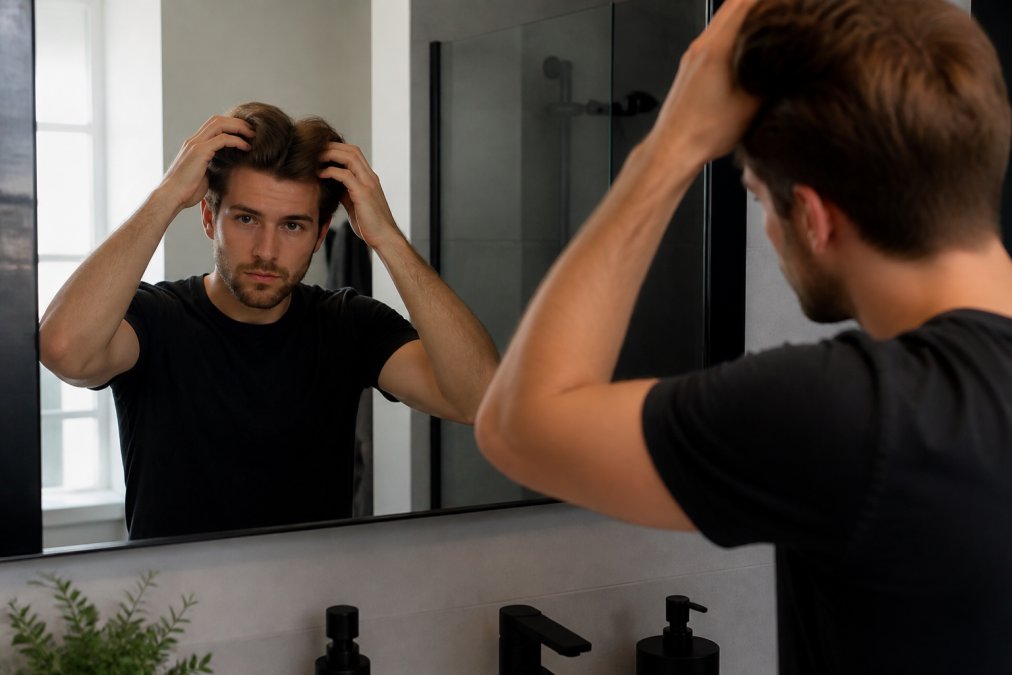
For a Textured Crop or French Crop
This cut relies on forward movement and visible texture on top, with shorter, blended sides. The goal is definition without a hard shell.
- Post-shower prep: Towel-dry until damp. Apply a pea-sized amount of a leave-in conditioner with hydrolyzed proteins (e.g., keratin or wheat protein) to the mid-lengths and ends. This prevents the cuticle from swelling unevenly, which leads to frizz.
- Pre-style with heat: Use a blow-dryer on low heat with a diffuser nozzle. Push hair forward with your fingers, not a brush, to encourage the natural direction of the crop. Stop at 80% dry; leaving slight moisture allows the next product to spread evenly.
- Apply a flexible clay: Emulsify a fingertip-sized amount of a water-soluble clay (look for bentonite or kaolin as texturizers, not as primary hold agents) between your palms. Work it through the top section only, from back to front. Avoid the sides; they are short enough to hold their own shape.
- Shape and set: Use your fingertips to pinch small sections of the top, lifting upward to create separation. Do not comb. Let it air-dry for three minutes. If you need extra security at the hairline, press a tiny amount of product (half a pea) along the front edge, but do not rake it through.
- Final check: The style should move when you shake your head slightly, then settle back. If it does not, you have used too much product; see the troubleshooting section below.
For a Modern Pompadour or Quiff
This cut demands volume at the crown and a clean sweep back, which is a common failure point for stiff products that collapse under the weight of thick hair.
- Damp hair, not wet: After towel-drying, apply a nickel-sized amount of a lightweight mousse or volumizing foam to the roots of the top section. Mousse provides lift without the film-forming polymers found in gels.
- Blow-dry with a round brush: Use a medium round brush (approximately 5 cm diameter) to lift the hair at the root while drying. Direct heat upward, not downward, to avoid flattening the volume. Dry the top to 90% before moving on.
- Apply a flexible paste or cream: Emulsify a fingertip-sized amount of a paste that lists water as the first ingredient. Work it through the top, starting at the crown and moving toward the forehead. Do not touch the sides; they need no product to stay clean.
- Sweep and pin: Use a wide-tooth comb to sweep the top back and slightly to the side. Do not force a perfect line; a slight natural part looks intentional. Let the hair cool for two minutes so the polymers set.
- Finish with a mist, not a spray: Hold a flexible-hold hairspray (one that contains polyurethane, not just PVP) 30 cm (approximately 12 inches) away and mist lightly over the top. This adds humidity resistance without the crunch of a stiff spray.
Why Cut-Specific Routines Matter
A textured crop has more exposed ends, so it absorbs product faster and needs a lighter touch. A pompadour has longer hair that bends at the mid-shaft, requiring a product that flexes without breaking. Matching the routine to the cut is the difference between a style that holds and one that looks stiff or collapses by noon.
Common Mistakes That Make Thick Hair Stiff
The most common mistake is applying product to bone-dry hair, which resists even distribution and causes stiff, flaky patches. Another frequent error is using too much product; start small and add gradually.
Skipping emulsification applies cold, concentrated product directly to the scalp, creating clumps that are impossible to distribute evenly. A product labeled "maximum hold" or "extreme" will inevitably produce stiffness; always select medium or flexible hold formulas for a natural look.
Troubleshooting Crunchy Hair After Product Application
Crunchy hair is not a product failure; it is a chemistry mismatch. The crunch comes from film-forming polymers (like PVP) that dry into a rigid lattice around the hair shaft, cracking into flakes when thick hair moves. The fix depends on why the lattice formed; here is a diagnostic approach based on the most common causes.
Cause 1: Product Overload and Porosity Mismatch
High-porosity hair (raised or damaged cuticles) absorbs product quickly but releases it unevenly, leading to dry patches. Low-porosity hair (flat cuticles) repels product, so it sits on the surface and dries into a shell. Most men do not know their porosity, so they apply the same amount regardless.
The fix: If hair feels crunchy within 30 minutes, you likely used too much for your porosity. Dampen your hands with warm water (not cold, which seals the cuticle) and gently squeeze hair from mid-length to ends to rehydrate and redistribute the polymer lattice. Do not rake, which breaks it into flakes. If crunch returns after drying, use a smaller amount next time.
Cause 2: The Wrong Polymer System
PVP (polyvinylpyrrolidone), a common film-former in gels and sprays, dries hard and is not re-workable. Polyurethane-based polymers and acrylate copolymers are designed to flex, forming a network that bends with the hair rather than cracking against it.
The fix: If PVP appears in the top five ingredients, the product will likely stiffen. Look for "polyurethane" or "acrylate copolymer" instead; these are water-soluble and re-workable, so you can reactivate them with a mist of water without starting over.
Cause 3: Applying to Bone-Dry Hair
Dry hair has a rough cuticle surface, so product catches on raised edges and clumps, drying into hard nodules.
The fix: If you applied to dry hair and it feels crunchy, do not add more product. Mist hair lightly with water from a spray bottle (about 15 cm away) and smooth the product through with your fingers; the water dilutes the polymer concentration and lets it flow into gaps. For future applications, always start with damp hair.
When to Wash and Restart
If crunch persists after two reactivation attempts, the product has bonded too tightly to the cuticle. Wash with a clarifying shampoo (containing sodium lauryl sulfate, not a sulfate-free formula) to strip residue, then follow with a lightweight conditioner. Wait until hair is completely dry before reapplying a smaller amount of a flexible-hold product.
The Porosity Angle Most Guides Miss
Men with high-porosity thick hair (often from heat styling or chemical treatments) experience crunch even with flexible products because raised cuticles absorb the polymer solution, but water evaporates quickly, leaving polymer concentrated inside the shaft. The fix is to apply a leave-in conditioner with glycerin or aloe vera before styling; this fills cuticle gaps and slows evaporation, allowing even distribution. Men with low-porosity hair should use a smaller amount and apply to damp, not wet, hair to prevent surface buildup.
Final Thoughts on Styling Thick Hair Naturally
The difference between stiff, helmet-like hair and a natural finish comes down to product chemistry and application technique. Styling thick hair without stiff hold is achievable by prioritizing flexible polymers, water-soluble ingredients, and the damp hair application method over heavy waxes and maximum-hold gels.
Jones Horizon offers premium, engineered grooming solutions designed specifically for the modern man. Our collection of conditioners, styling sprays, gels, and clays provides all-day hold and healthy nourishment without any crunch or flaking. Whether you are looking for a natural matte finish or a high-shine look, our products help you elevate your style with ease. Experience the perfect balance of performance and care for every hair type. For a polished look that moves naturally from morning meetings to evening events, explore the Jones Horizon collection and experience the balance of performance and care.
Frequently Asked Questions
How do I style thick hair without it feeling stiff or crunchy?
Switch from traditional gels to lightweight styling creams, pastes, or clays that offer a flexible hold. Apply the product to damp hair, emulsify a small amount between your palms first, and use a layering technique. Start with a pea-sized amount and add more only if needed. This prevents product buildup, which is the main cause of the crunchy texture and flaky finish.
What are the best lightweight hair products for men with thick hair?
Look for water-soluble styling creams, pastes, and clays labeled as lightweight or offering a medium, malleable hold. These products use flexible polymers instead of stiff resins. Check the ingredient list for water-soluble components and avoid products heavy in waxes that can lead to buildup. These formulas provide texture definition and weightless control without weighing thick hair down or leaving residue.
How do I achieve a natural matte finish on extremely thick hair?
Achieving a matte finish on thick hair requires a product with clay or specific matte polymers, not just any styling product. Apply a small amount of matte paste or clay to towel-dried hair, focusing on the roots for lift. Style as desired and let it air-dry or use a blow-dryer on a low setting. Avoid oil-based products as they can create unwanted shine.
Why does my hair feel crunchy after using styling products, and how can I fix it?
A crunchy texture usually means you applied too much product or used one with a stiff, high hold that dries hard. To fix it, try running your fingers through your hair with a drop of water to break up the cast. For a long-term solution, switch to a product offering a re-workable style with flexible polymers and apply less product to damp, not soaking wet, hair.